By Danny Gavin, AEM Communications Coordinator --
Roger Hoy’s career in agricultural engineering evolved through opportunity, timing, and a deep understanding of both industry and academia – an uncommon combination that ultimately shaped his nearly two decades as Director of the Nebraska Tractor Test Lab (NTTL) at the University of Nebraska.
Hoy looks back fondly on his tenure with the NTTL, and the unexpected opportunities that paved the way for his future success.
“You just don’t know where your career is going to take you,” Hoy reflected, noting that many of the most meaningful opportunities in his career were ones he never anticipated.
A Lifelong Commitment to Agriculture
Hoy grew up on a 200‑acre cow‑calf operation in Georgia, where early exposure to agriculture sparked his interest in engineering. That interest led him to pursue a degree in agricultural engineering at the University of Georgia, followed by graduate and doctoral studies at North Carolina State.
“I kind of knew from a young age that I wanted to be an engineer,” said Hoy. “And then I discovered, well, there's agricultural engineering, which is a nice marriage of everything.”
After completing his PhD, Hoy spent several years in industry before working with AEM member company John Deere. His tenure at Deere served as the foundation of his future work, particularly his work in regulatory standards and global policy discussions. Hoy represented Deere in conversations with regulators around the world, giving him a front‑row seat to how standards are shaped.
Making an Impact at the Nebraska Tractor Test Lab
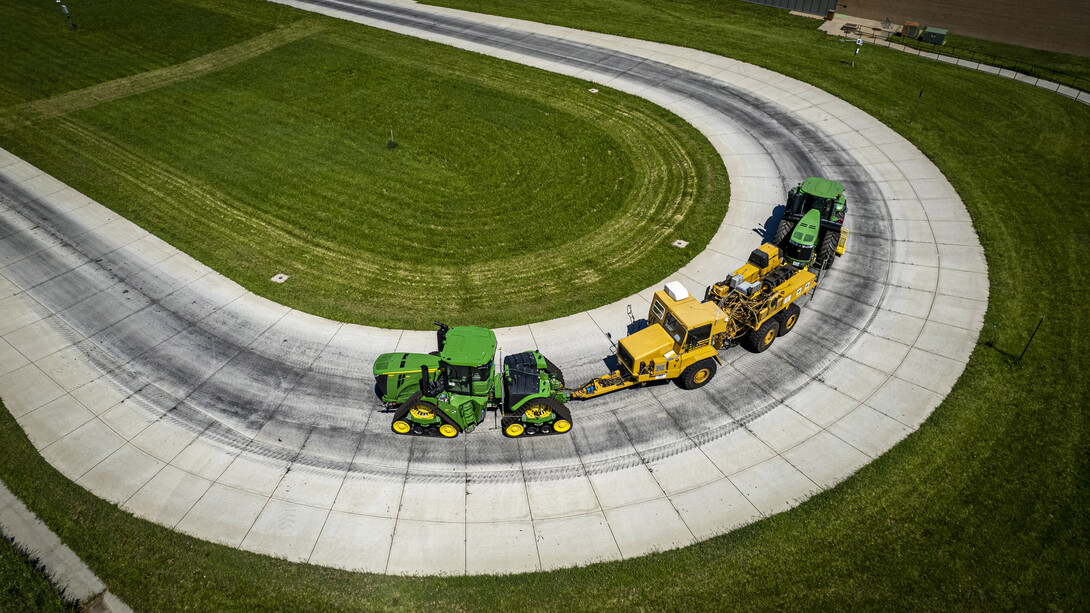
That experience ultimately led Hoy to the Nebraska Tractor Test Lab in 2006. Though the lab is best known for its formal testing and certification role, Hoy said what kept him there wasn’t just the technology, it was the people.
Working with students and mentoring future engineers became one of the most rewarding aspects of the role. At the same time, his industry background helped him serve as a bridge between manufacturers, regulators, and farmers.
“Fairness and credibility are everything,” Hoy explained. “It's interesting, because I get to play different roles and when I'm with manufacturers, I get to play the role of consensus-builder or peacemaker.”
At NTTL, that meant treating every manufacturer the same and maintaining trust across the industry. Hoy’s ability to understand manufacturer motivations while keeping the farmer, the lab’s ultimate customer, at the center of decision making helped guide meaningful changes to testing practices over time – and many of those changes were driven by listening.
What the Future May Hold
Looking ahead, Hoy sees automation as the most disruptive technology facing agriculture. While electrification often dominates headlines, he believes widespread electric tractors remain decades away due to cost, runtime, and charging limitations. Automation, however, has the potential to fundamentally reshape farming operations.
Rather than ever‑larger machines, Hoy envisions a future with multiple smaller, automated units working together – allowing for more precise input application and closer alignment with agronomic needs.
“We're trying to optimize operations, whether it's growth or reduced input cost,” said Hoy. “I think it'll be a big cultural shift, but I know it’s a shift that farmers will accept.”
Hoy retired in early January, handing leadership of the Nebraska Tractor Test Lab to Eric Smith, a fellow John Deere veteran. With strong industry relationships and experience with international testing standards, Smith continues a legacy which Hoy believes is critical to the lab’s credibility and success.
Reflecting on his career, Hoy emphasized that its defining feature wasn’t a single role or innovation, but the balance between industry and academia, innovation and practicality, and progress and trust. It’s that balance that allowed the NTTL to evolve alongside the machines it tests, while remaining grounded in the needs of those who rely on them.
Eric Smith Steps Up to Champion the Industry
Eric Smith’s career reflects a rare blend of hands-on agricultural experience, deep engineering expertise, and a long-standing commitment to industry collaboration. Now serving as Director of the NTTL, Smith brings decades of perspective shaped by time spent on farms, in design offices, and at standards tables across the ag equipment industry.
Smith graduated from Cornell University in 1994 with degrees in agricultural and mechanical engineering, and entered the agricultural equipment industry immediately, beginning his career at AEM member company New Holland.
“I'd grown up on corn and soybean farms in Iowa, and wheat farms in Oregon, so I understood harvesting, but actually to be on the design side was really interesting,” said Smith.
Early roles took him to tractor manufacturing facilities and into field testing and product support, where he gained firsthand exposure to how equipment performs under real-world harvesting conditions.
That grounding proved valuable when Smith joined John Deere, where he spent nearly three decades in a variety of engineering and design roles. Smith’s work helped him appreciate the full lifecycle of equipment, from design to dealer support, and reinforced the importance of solving customer challenges at every stage.
Later in his career at Deere, Smith transitioned into standards and regulatory work, a move he did not originally anticipate. Encouraged by colleagues, he discovered that the role allowed him to apply broad technical knowledge while contributing directly to the development of safety and performance standards.
Through this work, he became deeply engaged with AEM and gained exposure to the Nebraska Tractor Test Lab and its role within the global testing and certification ecosystem. As current Director of the NTTL, Smith looks forward to applying his varied background to his work.
Looking To the Future
Smith noted that electrification and automation are two trending technologies in his work today, especially as battery/electric tractors begin to exceed the 100-hp threshold that triggers Nebraska testing requirements.
“I think there are users right now, farmers right now, who have a need for something like an electric tractor,” said Smith. “An electric tractor is quieter, and has different emissions or no emissions, which may appeal to specialty crop farmers.”
Beyond technology, Smith emphasized the lab’s educational mission. Located adjacent to the university’s biological systems engineering department, NTTL exposes students to applied engineering. Student workers participate in testing new tractors and interact directly with OEM representatives, gaining insight into product development and potential career paths. Smith described it as a unique opportunity to connect academic learning with real-world applications.
“Students are being exposed to applications engineering – we're not doing research like a lot of other facilities on campus,” said Smith. “We're getting those new tractors, and the students have the opportunity to see that new that technology being applied.”
NTTL’s work is described as a partnership with the industry rather than a process conducted in isolation. Through formal agreements and ongoing coordination, manufacturers, engineers, and testing officials collectively contribute to testing procedures that are rigorous, practical, and focused on user confidence and safety.
With a career shaped by agriculture, engineering, and standards development, Smith now brings a comprehensive perspective to the Nebraska Tractor Test Lab, one that reflects both the industry’s history and its rapidly evolving future.