By Danny Gavin, Communications Coordinator, Association of Equipment Manufacturers (AEM) --
Sustainability conversations in non-road equipment manufacturing often focus on factory operations, emissions reductions, or energy consumption. While those efforts remain important, some manufacturers are making their greatest environmental impact through the work their products enable every day in the field.
For AEM member company Indeco North America, a leading brand in the construction, demolition, and forestry industries throughout the world, sustainability is closely tied to the industries its attachments serve. From demolition and recycling to scrap processing and forestry management, the company's products help contractors recover materials, reuse resources, and reduce waste that would otherwise end up in landfills.
"We make attachments that are used in construction, demolition, and recycling applications every day," said Indeco Marketing Director Ryan Murphy. "We make steel cutting shears, which are used not only in demolition, but more prominently in metal recycling and scrap recycling."
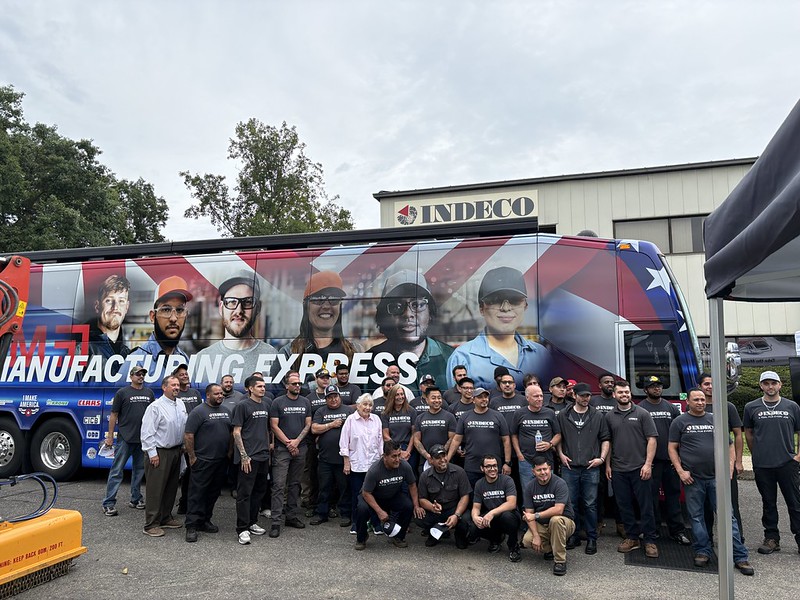
The Northeast leg of the AEM Manufacturing Express was proud to make a stop at Indeco North America on Sep. 2, 2026. For more information and to follow along with the tour, visit manufacturingexpress.org.
Supporting Material Recovery
As the construction industry places greater emphasis on recycling and material reuse, demolition contractors are increasingly being asked to recover as much material as possible from jobsites. Equipment attachments play a central role in making that process more efficient.
Indeco's steel shears, concrete pulverizers, and material handling grapples are designed to help contractors separate, sort, and process recyclable materials during demolition projects.
According to Murphy, nearly every concrete structure contains valuable recyclable materials.
"Inside every bit of concrete that gets torn out of a former installation is steel, is rebar, is reinforcing material that gets separated out and recycled for scrap," he explained.
The concrete itself can often be repurposed as aggregate or base material rather than hauled away as waste. "There's more and more pressure on really everybody out there in that demolition field to find more uses, to reclaim more material, and find new ways of reusing it," Murphy explained.
"There's a lot of stewardship in what our products are and what their uses and applications are,” Murphy said. "It's really the continued development of new technologies, of better ways to reuse more materials out in the demolition world, in the recycling world, that will drive us forward as it relates to sustainability." -- Ryan Murphy
Enabling Sustainable Business Practices
For Indeco, the connection between sustainability and profitability is increasingly being driven by the success of customers working in recycling and material recovery markets.
While the company continues to improve sustainability practices within its own operations through initiatives such as solar energy installations, LED lighting upgrades, recycled machining fluids, and domestically sourced steel, Murphy believes the larger impact comes from the applications its products support.
"There's a lot of stewardship in what our products are and what their uses and applications are,” Murphy said. "It's really the continued development of new technologies, of better ways to reuse more materials out in the demolition world, in the recycling world, that will drive us forward as it relates to sustainability."
That perspective reflects a growing recognition across the equipment industry that sustainability initiatives can create both environmental and business value simultaneously.
Sustainability is everyone’s business. Whether it’s through aligning with ever-evolving regulations or working to support a more viable world, the non-road equipment manufacturing industry and its future depend on its ability to maximize efficiency, minimize cost, and use natural resources responsibly. Learn more.
Beyond Recycling
Indeco's sustainability impact extends beyond demolition and recycling. The company's forestry mulching attachments also support vegetation management efforts that help mitigate wildfire risks, maintain utility corridors, and improve access to critical infrastructure.
According to Murphy, forestry mulchers are increasingly being used to create fire breaks and remove vegetation that can serve as fuel for wildfires, particularly in the western United States. The attachments are also used along power lines, railways, and transportation corridors to improve safety and support ongoing maintenance operations.
Looking Ahead
As recycling requirements, material recovery expectations, and sustainability goals continue to evolve, non-road equipment manufacturers will be expected to help contractors do more with fewer resources.
Murphy believes the industry's focus will remain centered on efficiency, productivity, and finding new ways to maximize the value of materials already in circulation.
"Manufacturers need to continue changing with the times," he said. "We need to find new ways to get more efficiency and more revenue-generating uses out of equipment while continuing to follow those trends."
For companies like Indeco, sustainability may not be defined solely by what happens within manufacturing facilities. Increasingly, it is being measured by what equipment enables customers to accomplish once it reaches the jobsite. Through recycling attachments, scrap processing solutions, and material recovery technologies, manufacturers are helping make the circular economy a reality, one project at a time.