By Gregg Wartgow, Special to the Association of Equipment Manufacturers (AEM) --
Skills-driven career pathing has become a focal point for many employers. By establishing a learning framework based on clear and measurable job-specific skills, companies can develop the training resources needed to develop their people faster, leading to better outcomes with more transparency and legitimacy.
Establishing the learning framework doesn’t happen with the snap of a finger, however. Companies must be willing to sit down and scrutinize existing training efforts, talk with all learning stakeholders to identify gaps, and embrace a different way of delivering training to employees.
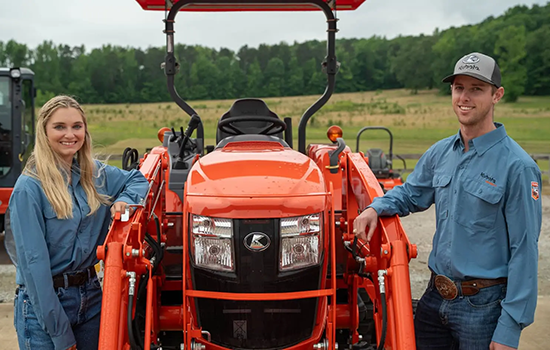
AEM member company Kubota Canada has been working through this type of transition. It all stemmed from a moment of frustration a few years ago.
“You create all of this great learning content and it goes well, but you still hear rumblings about the need for better curriculums and more consistency,” said James Lavis, manager of learning and development at Kubota Canada in Pickering, Ontario. “That doesn’t seem to make sense. The learning assets should be doing what they are intended to do, but you’re still getting these random questions. That can be very frustrating.”
Lavis and his team decided to get to the root of those rumblings. They started by exploring what their biggest employee/customer segment thought about the training Kubota Canada provided.
“We started doing dealer focus groups in October 2023,” Lavis said. “The objective was simply to listen. Very quickly after those dealer focus groups, we knew we needed to change things.”
Lavis and his team began developing a training framework based on a set of guiding principles:
- All training must be focused on people, not projects or business objectives, etc.
- Training must be role-specific
- Training can’t just be about checking boxes; it must be capable of moving someone toward behaving in desirable way
The new framework ultimately came to be known as Kubota Pathways.
Want to learn more about how to attract and retain the workforce of tomorrow? AEM is here to help bring them to light through its Workforce Development Committee. Learn more.
Define Work First, Develop Training Second
The fundamental premise of Kubota Pathways is that you can build the training people need when you understand what the job requires.
According to Lavis, HR staff should take ownership of the job description process. But that doesn’t mean they should take it all upon themselves. They should work with hiring managers to make sure job descriptions are clear and up to date. HR staff should also talk to employees who are actually doing those jobs.
“Start the process with one job in the company,” Lavis suggested. “Write down everything you think a person in that role should know and do. Then ask the same thing of the hiring manager. Then ask someone who actually does the job to write the same list.”
The goal is to get all three in alignment, and capture it all in a single document that everyone in the company understand and agrees with. From there it becomes easier to develop learning materials that support the development of employees in that specific role. You also have the opportunity to conduct clearer performance reviews because there are no longer gaps with respect to expectations.
“If the hiring manager ever says, ‘this and this need to be changed in the job description,’ that’s something you can do,” Lavis related. “But now you can also say that if the job description is changing, the learning materials may need to be updated, too.”
With a learning framework like Kubota Pathways, everything is driven by a clear understanding of each role.
More Resources, Less Memorizing
With respect to the learning materials themselves, Lavis said his team has made another important change that ties to the feedback received during those dealer focus groups in 2023.
“Prior to that, we’d been expecting dealers to remember information on selling and servicing around 1,400 products,” Lavis pointed out. “But why? We thought about it and realized people only need to retain, or memorize, the core of certain things. Then they simply need to know how to find the rest. That understanding influences the types of learning materials you build.”
Kubota Canada has shifted to a 65/15/20 approach to learning. Dealers need to memorize/retain 15% of the learning material, know how to find 65%, and then experience the remaining 20% through hands-on training, equipment demos, etc.
“Future forward, we’re going to produce more guides that our dealers can read,” Lavis explained, adding that those guides can be something as simple as a PDF. As long as it’s readable on a phone, downloadable, printable, and easy to access at any time, it can support that 65% of learning. Kubota Canada is actually working on an app that allows dealers to quickly look up (find) tractor specs.
Another important change Kubota Canada has made is developing learning materials based on what an employee needs to know vs. what they need to be able to show (i.e. demonstrate a skill). Each type of learning need is better suited to certain types of learning formats. For example, when it’s determined that an employee needs to know something, a written learning asset is developed. When they need to know how to show something, a video is typically created.
Onboarding Resources vs. Career Pathing
Lavis and his team also began organizing learning assets into two key categories: onboarding materials for new employees which they call Trailhead, and career development materials for existing employees which they call Trail Pass.
They looked at existing learning materials and courses, and worked to connect them more seamlessly through common tools like learning management systems (LMS). For the future, however, Lavis and his team want to lean into the learnings from those 2023 dealer focus groups. They want learning content to be organized like an old TV Guide so employees can “find” what they need when they need it, whether that’s a learning material, workshop, training event, etc.
“We want to capture every piece of learning content we have going on, and put it all on a list for our dealer network,” Lavis pointed out. “It’s really nothing groundbreaking. It’s just a matter of telling dealers there are certain trainings going on in certain windows, and then giving them an easy way to scan or click so they can go to the right spot to view it, sign-up, or whatever.”
Request information from AEM on best practices, tools, programs, and resources to help you attract and retain the right talent. Strengthen your workforce strategy.
Building Training Resources Under the New Framework
Kubota Canada has been transitioning to the new Kubota Pathways approach for a couple years now. It remains a work in progress, as any massive undertaking like this would. Lavis said it may be unrealistic for an organization to think it can go through all existing training materials and update everything all at once. That’s why Kubota Canada has committed to ensuring all new learning content is anchored to the three guiding principles mentioned earlier:
- All training must be focused on people, not projects or business objectives, etc.
- Training must be role-specific
- Training must be capable of moving someone toward behaving in desirable way
As for the existing content, Kubota Canada is also in the process of building and testing an AI machine learning model that can assist in the massive undertaking. Lavis said they are able to share existing learning material and job descriptions with the model. The model can then analyze the content, organize it into user-friendly charts, separate the knows and shows, and identify gaps. A human always reviews the model’s analysis to see if it needs refining. In fact, Lavis said it’s a good idea for HR, the hiring manager, and an employee to all review it to make sure there is alignment.
At the end of the day, Lavis said instructional design should be at the core of onboarding and career pathing nowadays. While tools like AI can definitely help, it really comes down to understanding what the employees of your company or dealer network do, which enables you to build the right learning materials to meet those needs.