By Gregg Wartgow, Special to the Association of Equipment Manufacturers (AEM) --
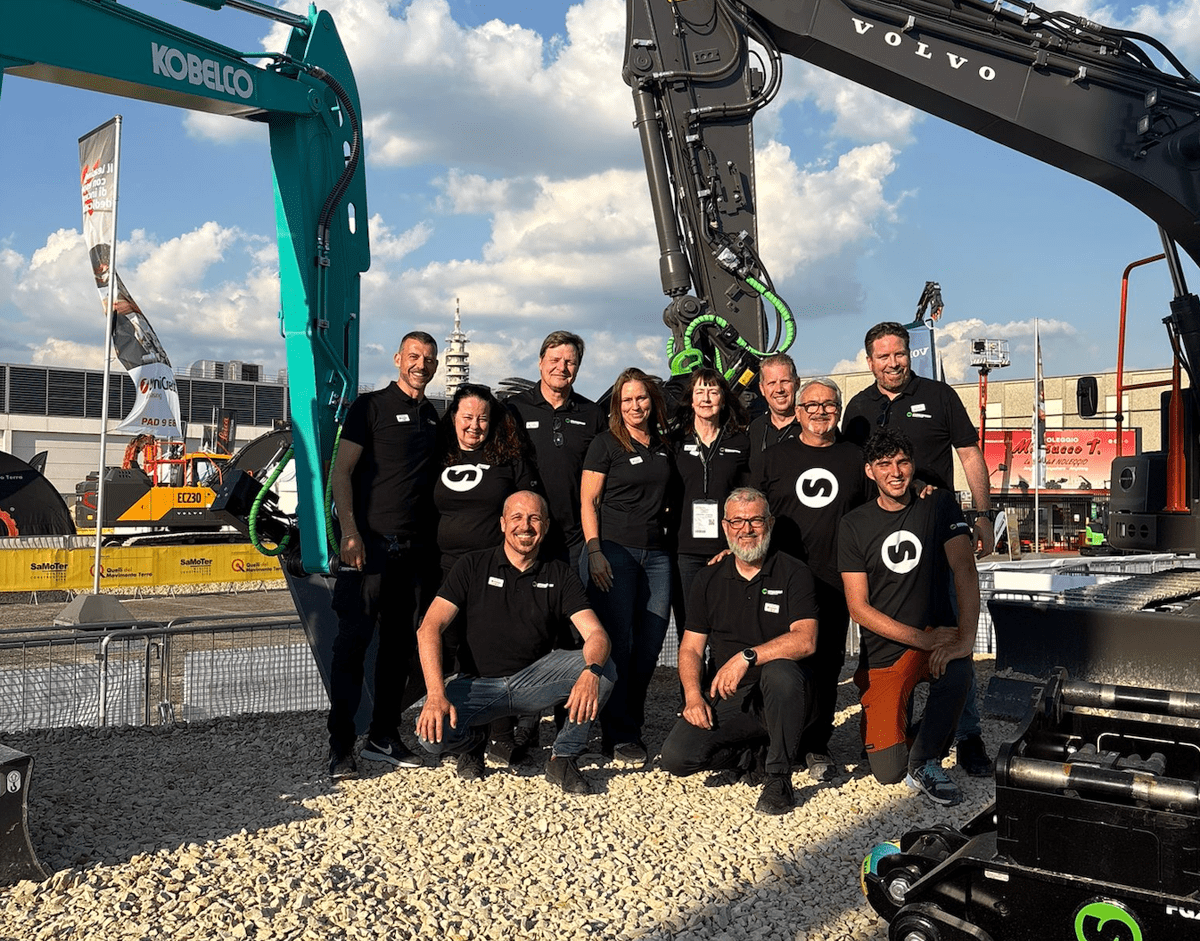
AEM member company Steelwrist’s manufacturing capabilities and financial performance are two reasons why it has been named one of Sweden’s Best Managed Companies, an awards program sponsored by Deloitte in partnership with Swedbank, one of Sweden’s leading banks.
But what truly puts Steelwrist over the top is how the company’s strategic vision helps drive the corporate culture, including here at the company’s North American headquarters in Newington, Connecticut.
“A substantial amount of work goes into preparing your application for this award,” said Karl Serneberg, vice president of OEM sales and marketing at Steelwrist. “Preparing your application is an excellent exercise because it helps align your business strategy. Plus, you get an outside view to help assure that everything you’re doing ties together.”
The Northeast leg of the AEM Manufacturing Express is proud to make a stop at Steelwrist on Sept. 28, 2026. For more information and to follow along with the tour, visit manufacturingexpress.org.
Steelwrist has received that assurance seven consecutive years now. Company leaders like Serneberg, CEO Stefan Stockhaus, and CTO Markus Nilsson are confident that Steelwrist is on the right track to continue growing the company and building market share — particularly in North America.
“That’s a big reason why I decided to join Steelwrist in the first place in 2023,” said Peter Gaj, vice president of the Americas region, who’d previously spent 14 years with prominent New England dealership Tyler Equipment. “The North American market for our flagship product, the tiltrotator, is like a volcano right now. It’s exciting to be part of that, and we want everyone in the company to feel the same way. We’re not just building another piece of construction equipment. We’re building a brand and a market that we believe can change the industry. To do that, you need buy-in from everyone — whether they’re in the warehouse, administrative office, or engineering department.”
How Strategy and Innovation Influence Culture
Steelwrist was founded in 2005. Based in Rosersberg, Sweden, the company now has a presence in 19 countries, including the U.S. for the past nine years. Despite its broad footprint, Serneberg said Steelwrist has an edge as a smaller, privately held company.
“We’ve been able to maintain a consistent strategy over the years,” Serneberg related.
That consistently clear vision has enabled Steelwrist to attain employee buy-in throughout the organization, which has also helped the organization gain recognition as a best-managed company for so many years; the awards program places a lot of emphasis on corporate culture and engagement.
What is that clear vision? According to Serneberg, it’s to help ensure customers have an emotional connection with the Steelwrist brand.
“This has been our strategy for many years, long before we ever won our first award in 2020,” Serneberg pointed out. “It’s a simple strategy that is easily communicated across our entire organization around the world. Each of our 300 employees knows it.”
Employees are also tasked with thinking about how their actions can help support the company’s strategic objective. All ideas are welcome, and employees are welcome to share them with whomever they want.
“In all regions around the world, including here in North America, we strive to project an open-door policy,” Gaj said. “For instance, anybody who reports to me can feel comfortable about picking up the phone and calling the CEO at any time. That’s the culture our co-founder and CEO has wanted to portray from the very beginning.”
Gaj said he talks about this strategy when interviewing prospective new employees.
“Their eyes get really big and they’re almost shocked,” Gaj related. “But this strategy is one thing that has allowed our company to grow so quickly, including here in North America.”
Innovation has had something to do with Steelwrist’s growth too. And just like with the company strategy, everyone is focused on it.
“There have been times when I’m walking around our office and see our co-founder and CTO on the production floor taking measurements and looking at components,” Serneberg related. “He is our CTO, but he is just as engaged in the product design as our engineers.”
Employees can see that, which inspires them to remain just as engaged.
“The best ideas can come from anyone in the company, and they come from that kind of environment where idea-sharing is encouraged,” Serneberg said.
In North America specifically, the innovation is inspiring because tiltrotators are much more common in the Nordic countries than in North America. “In fact, there’s about a 99% difference in terms of adoption and market share,” Gaj pointed out.
One could view that as a major disadvantage. But for Gaj and his team in Connecticut, they view it as an opportunity to really move the needle through innovation.
“We want everyone in our company to understand the true aspect of what we are manufacturing, not just their specific role in the company,” Gaj said. “To that point, it’s not uncommon to take office staff on a tour across the assembly floor to see our products being assembled.”
Going one step further, new employees make a trip to Steelwrist’s global headquarters in Sweden as part of their onboarding. They aren’t just doing a meet and greet with CEO or touring the facility either.
“New employees actually help assemble quick couplers and tiltrotators,” Serneberg said. “We want everyone to be very mindful of how the operation works from start to finish.”
Want to learn more about how to attract and retain the workforce of tomorrow? AEM is here to help bring them to light through its Workforce Development Committee. Learn more.
“We recruit through our core beliefs and our culture. To us, sharing our vision for the culture is even more important than the skills to perform a certain job.” -- Karl Serneberg
Core Values Further Feed the Culture
Steelwrist’s core values are as well-understood as the company’s broader strategy. The two go hand in hand, really, which is why Serneberg said there must be more to it than just a slide in a presentation. What matters is how each layer of the organization lives the core values every day.
“We recruit through our core beliefs and our culture,” Serneberg said. “To us, sharing our vision for the culture is even more important than the skills to perform a certain job.”
So, what are the core values that help nurture the Steelwrist culture? There are three of them.
- Responsiveness. This is especially important to a company like Steelwrist because the core product is still considered new in many markets around the world. “Responsiveness means we listen,” Serneberg said. “We listen to our customers, suppliers, and employees because that’s where the good ideas and feedback come from.”
- Simplicity. This is the goal of engineers with respect to the products themselves, but also company leaders with respect to how the various teams complete their work. “We strive to keep processes as simple, yet effective, as possible,” Serneberg said. “For example, the company uses one ERP that ties in every subsidiary around the world. That is simplicity.”
- Speed. Steelwrist hasn’t been around as long as its main competitors. To gain an edge, Serneberg said teams have to be faster to respond and faster to market. “We work with speed in everything we do,” Serneberg said. “We have to work smarter, but also harder.”
Case in point, Gaj pointed to a recent project that came together even faster than he’d hoped. He personally had the idea of making a quick coupler for wheel loaders, which would complement Steelwrist’s flagship product designed exclusively for excavators. Within eight months, the concept was in production.
That kind of action is the byproduct of Steelwrist’s manufacturing capabilities, for sure. But it’s also the result of the company’s core values and overarching strategy that require everyone’s input and effort to make successful.
“You can’t be stagnant in this industry,” Gaj said. “You must continue to innovate and have a forward-looking vision, and everyone has to buy into it.”