As difficult as 2025 was for construction and agriculture, the year closed out on a somewhat positive note.
Modest improvements began to materialize across both industries, a trend the non-road equipment manufacturing industry is hoping to build on in 2026 and beyond.
“Now we’re starting to see signs of stabilization, and maybe even some of the first signs of recovery,” said Al Melhim, AEM’s senior director of business intelligence. “This is really good news, and it really matters with respect to how AEM members prepare for the year ahead.”
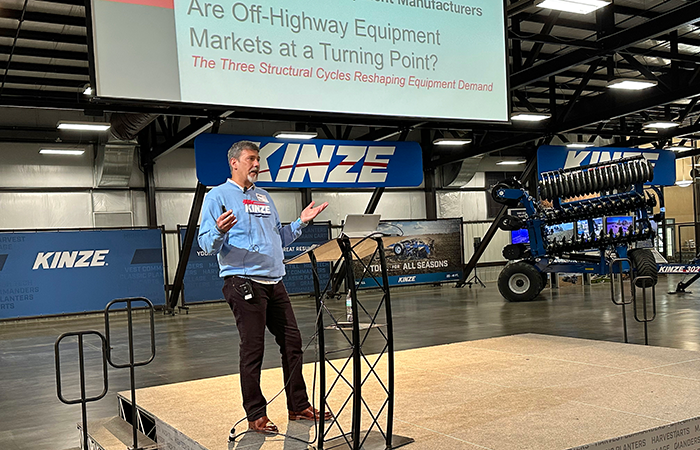
Melhim was a featured presenter during AEM’s first of four “Business Intelligence Equipment Market Update” webinars set for this year. Melhim, together with Tom Hopgood, a construction economist for GlobalData, discussed where the agriculture and construction industries appear to be headed in the months ahead.
Stay on top of emerging industry trends with AEM’s quarterly Business Intelligence Equipment Market Update webinars, where leading experts break down industry issues and pinpoint crucial changes in the landscape to AEM member companies refine their strategies. Save a spot at the next webinar.
Are Ag’s Ugliest Days Behind It?
Melhim said 2025 was the most challenging in recent memory for the agriculture industry, particularly with respect to high-horsepower equipment. Strained by thin margins, poor credit conditions, and weak liquidity, U.S. farmers didn’t have the confidence to invest in large-ticket items.
“Farmers had shifted their resources toward maintenance, repairs, retrofits, and incremental upgrades, rather than full equipment replacements,” Melhim said.
Low-horsepower tractors also ticked lower in the U.S. last year, although Melhim said the contraction was much more manageable. After some big growth years following the pandemic, unit sales settled around historic averages in 2025.
The Canadian market has been relatively stable, although high-horsepower equipment has also been lagging a bit — largely for the same reasons seen in the U.S.
The big question now is whether or not the ag equipment industry has reached its bottom. Melhim said it probably has, with the most likely scenario being normalization in equipment markets with growth in selective segments this year. And even though the current financial environment continues to favor retrofits over full equipment replacements, manufacturers have seen a strengthened production pipeline. That’s a good reason for optimism.
“All in all, it’s good to know it’s all a gradual improvement from the lows of 2024 and 2025,” Melhim said.
AEM offers monthly United States Ag Tractor and Combine reports that compile the previous month's sales for tractors and combines. Learn more.
Trends Affecting Ag Equipment
Reduction in carryover inventory. Ag equipment shipments decreased faster than sales in 2025, particularly in the case of high-horsepower equipment. This inventory cutback was a strategic move in both the U.S. and Canada. That said, both high- and low-horsepower equipment stood above their 25-year averages in both the U.S. and Canada. Thus, Melhim said the industry must continue tightening production and inventory management to maintain market stability.
Equipment replacement cycles. Melhim said the replacement phase for low-horsepower equipment began around 2012 and has largely played out, thus creating less incentive for farmers to buy new equipment in 2026. High-horsepower equipment, on the other hand, could see some mild replacement-driven demand since the replacement cycle started more recently. That said, farmer liquidity will strongly influence whether any replacement-driven demand actually materializes.
Used tractor market. It’s a buyer’s market when it comes to smaller tractors, sprayers, and high-class combines, as units are relatively young and there is ample supply. With high-horsepower tractors, there is still an historically high volume of used equipment. However, equipment aging and inventory volume are both headed in the right direction, which is typically a prelude to improved new equipment demand. Mid-class combines are also aging and seeing tight supply.
Weak crop margins. Crop margins have struggled for nearly three straight years, adding to farmers’ financial strain. Production costs have hovered near historic highs for everything from fertilizer and chemicals to financing. At the same time, demand has continued to lag supply. “Even with U.S. government programs like the Emergency Commodity Assistance Program and Farmer Bridge Assistance Program, margins remain negative for all crops,” Melhim pointed out.
Financing still a burden. Despite numerous interest rate cuts in 2025, financing is still a challenge for farmers. Lenders have tightened credit standards, limiting access to capital. “The rate cuts alone might not cut it,” Melhim said.
Cattle margins strong. One bright spot in the agriculture industry has been the cattle market. Melhim said demand for beef is strong, feed costs have improved, and herd size is historically low — all of which support healthy margins and investment in new equipment.
“Now we’re starting to see signs of stabilization, and maybe even some of the first signs of recovery. This is really good news, and it really matters with respect to how AEM members prepare for the year ahead.” -- Al Melhim
Where Things Stand for Construction
GlobalData estimates that global construction output grew by a modest 0.5% last year. Now it’s reasonable to expect a return to more substantial growth this year of around 2.32%, Hopgood said. GlobalData is then projecting 3.49% and 3.54% growth in 2027 and 2028, respectively.
Global growth has been led by three regions in particular: South Asia, South-East Asia, and the Middle East & North Africa. Conversely, several regions saw declines in 2025: North America, North-East Asia, and Latin America.
Global growth has also been driven by the energy/utilities sector, along with infrastructure and industrial construction. Commercial construction has struggled as a whole, aside from the data center segment that is seeing growth. Residential construction has also struggled for several years, although stabilization and mild growth are anticipated this year.
A Closer Look at the U.S. and Canada
Construction output was negative 2.73% in the U.S. in 2025. A return to growth is expected this year, albeit just 1.08%. Growth in 2027 is expected to pick up, projected at 2.09%. According to Hopgood, the U.S. was hit hard in 2025 due to rising uncertainty and the fallout from tariffs.
Construction output in Canada was up 2.19% in 2025 and is projected to grow another 2.6% this year and 3% in 2027.
The commercial sector in the U.S. is expected to return to growth this year after a several-year struggle. That said, growth through 2029 is projected to be modest. As for the other key construction segments:
- Industrial construction will cool considerably this year
- Infrastructure is holding steady
- Energy/utilities and institutional are both cooling, yet will see growth this year
- Residential will grow modestly, finally emerging from its multi-year slump
In Canada, the three-year outlook for commercial construction is strong, with near 4% growth projected through 2029. With respect to the other key construction segments:
- Industrial and institutional construction will cool, but still see modest growth
- Energy/utilities and infrastructure will see slight improvements
- Residential will emerge from negative territory to see modest growth
Top Global Construction Challenges
Housing shortages. Major economies have been attempting to solve the global housing crisis for years. Unfortunately, ambitious goals have largely been unmet, often due to obstacles such as permitting delays and land-use restrictions, high construction and financing costs, surging populations, and a skilled labor shortage. In Canada, for example, a record high of 260,000 housing units were completed in 2024, yet current builds are happening at half the pace needed through 2030.
In the U.S., estimates from Goldman Sachs Research and others suggest a shortage of at least 3-4 million homes. The government has been taking steps to address this. The National Housing Emergency Act of 2026 aims to boost domestically produced materials like lumber, steel, and manufactured housing, as well as create a new federal funding standard for housing-related dollars. Another initiative is Trump Homes, which Hopgood said would establish a program where people could rent for three years with the option of purchasing. The impact of programs like these remain to be seen.
Skilled labor shortages. Only five other industries are having a tougher time filling open positions than construction. The global average is 93 days. Italy is experiencing the longest delays at 115 days. That number shrinks to 90 days in the U.S., although an estimated 349,000 workers are needed to meet demand this year.
Technology. One way to help mitigate labor shortages and improve productivity is through the use of technology — everything from software and augmented reality to drones, autonomous vehicles, 3D printing, and AI.
Hopgood said spending on construction management software specifically is projected to increase by a CAGR of 8.7% through 2030 across selected markets. India is expected to lead the way with nearly 14% growth in spending, followed by Canada, the United Kingdom, and the United States, each increasing their investments by roughly 9%.
Data centers. Even though data centers only represent 2% of the U.S. construction market, there is a massive pipeline of over $1.23 trillion in place — by far the largest in the world. The vast majority of those projects are still in the planning stage, Hopgood pointed out, noting that projects will begin entering the execution phase over the next couple of periods. According to Hopgood, one in seven construction contractors already had a data center project on the books.
About Quarterly Webinars
AEM members have exclusive access to benefits to help them stay on top of emerging trends via quarterly Business Intelligence webinars. Experts dissect industry issues and pinpoint crucial changes in the landscape to help attendees refine their company’s strategy.
Plan to attend AEM’s Q2 Business Intelligence Equipment Market Update Webinar on May 7, 2026.
For more information on the upcoming Q1 Equipment Market Update Webinar, contact your Account Success Advisor.