By Gregg Wartgow, Special to the Association of Equipment Manufacturers (AEM) --
“There are two ways to make money on a farm,” said Mike Mills, director of sustainability solutions at AEM member company Reinke Manufacturing, a manufacturer of irrigation systems. “You can sell your product for more or spend less producing it.”
It’s been a tall task for row crop farmers on both of those fronts in recent years.
“Input costs for things like fertilizer and pesticides have continued to rise, and unfortunately the price of commodities have not,” said Adam Barlow, manager of technology standards and regulatory affairs for precision agriculture technologies at AEM member company John Deere. “When you look at the price of corn today, it’s about where it was in the 1980s.”
That leaves few options for the profit-conscious crop farmer, aside from trying to reduce the amount of costly inputs they use.
“This is what precision ag helps accomplish,” Barlow pointed out. “By applying inputs more precisely, farmers are able to use less of them.”
In many instances, farmers are also able to produce more.
“It’s not always about a reduction in inputs,” said Austin Gellings, senior director of agricultural services at AEM. “It’s more about applying inputs as efficiently as possible. Crop output per pound of fertilizer used has increased significantly over the years. That’s a tangible benefit that makes farmers more profitable.”
Today’s precision ag technology on equipment can have an enormous positive impact on farmers and the environment, ultimately enhancing productivity through more efficient use of critical inputs, such as land, water, fuel, fertilizer, and herbicides. In short, farmers who use precision ag equipment use less to grow more. Download The Benefits of Precision Ag in the United States.
The Ripple Effect of Reducing Inputs
AEM’s newly released study, The Benefits of Precision Ag in the United States, quantifies how precision ag is helping farmers do more with less. The data speaks for itself:
- Crop production up 5%
- Fertilizer use down 8%
- Herbicide use down 9%
- Water use down 5%
- Fuel use down 7%
How tangible are those collective gains? A row crop farmer managing 1,000 acres could add roughly $118,000 to their bottom line.
Precision ag technologies are helping farmers benefit in ways that are more intangible, too.
“When growers start looking to invest in precision agriculture and irrigation technologies, a big part of their motivation ties to managing people and acres,” Mills said. “Crop farming operations are getting larger. When a grower can implement precision irrigation equipment, specifically telemetry, they can save a lot of time by not having to drive out to their fields to check equipment every day. When you’re a large grower managing thousands of acres spread out over a few states, the only way to manage your irrigation equipment is to do it remotely.”
There is also a ripple effect to precision agriculture that yields agronomic and sustainability benefits. As detailed in the AEM report, doing more with less is helping to improve growing conditions by
- Reducing field compaction
- Preventing waterlogging and dry-crusting
- Promoting root growth
- Supporting increased microbial activity
- Improving soil salinity
- Preventing the development of pesticide resistance
“Now that our targeted spray technology has been out there a few years, we’ve seen evidence that reduced pesticide usage can have a direct impact on crop yield,” Barlow shared as an example. “When blanket spraying pesticide over an entire crop, the grower will sometimes wind up with some crop damage — especially in soybeans where the leaves can start to curl up. The leaves will grow back out in most instances if the proper pesticide rate was applied. But some of that crop’s growth has been stunted, which could affect yield. When target applying, on the other hand, the grower isn’t putting that stress on the plant that doesn’t need to be sprayed.”
With respect to irrigation, Mills said everything ties back to the grower’s desire to be a responsible user of water. There’s a ripple effect there, too.
“A grower will see a reduction in pumping costs when they use less water because it takes energy (fuel or electricity) to run those pumps,” Mills said. “The bigger piece, though, is being able to accurately apply the water they’re using, which allows the grower to increase acreage or yield per acre with the same water flow. When we talk about sustainability, it’s more than just environmental responsibility. Sustainability is about sustaining ourselves as a population, which means we’re able to produce the food and fiber the world needs. That requires the responsible use of natural resources like water, and that’s what growers are doing with precision ag.”
For more than 130 years, AEM has helped advance equipment manufacturing and the agriculture and construction customers our industry serves by providing uniquely valuable insights and timely, relevant resources. Learn more at aem.org/insights.
“It’s not always about a reduction in inputs. It’s more about applying inputs as efficiently as possible. Crop output per pound of fertilizer used has increased significantly over the years. That’s a tangible benefit that makes farmers more profitable.” -- Austin Gellings
Efficient Application of Fertilizers and Herbicides
There are several precision ag technologies in use today that are helping row crop farmers do more with less.
The first that comes to mind is auto guidance, which uses GPS signals to automatically control a tractor while it’s seeding, spraying, spreading, or harvesting.
A second technology is machine section control, which automatically turns sections of a planter, spreader, or sprayer on/off to ensure that inputs are placed only where they’re needed.
A third technology, variable rate, uses sensors or preprogrammed maps to determine the ideal application rate for different sections of a field based on the agronomic needs of each section.
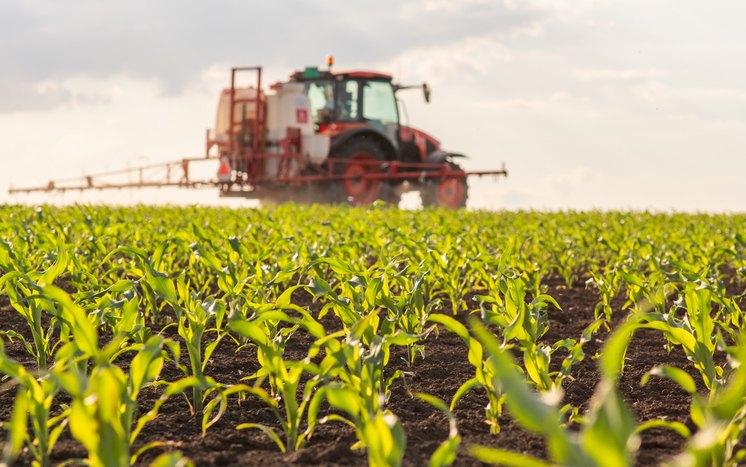
A newer technology is targeted spray application. Enabled by sensors (cameras) and artificial intelligence (machine learning), targeted spray turns on nozzles only when weeds are detected. This highly selective approach to weed control is helping growers slice herbicide use by anywhere from 50-90% according to various studies.
Targeted spray technology continues to improve. Initial offerings were capable of functioning in green-on-brown applications, meaning the cameras could detect weeds in fallow. Over the past few years, Barlow said the technology has evolved to where green-on-green weed detection is now possible, which means targeted spray can work effectively in crop canopies.
Another important development in targeted spray is the ability to work in a wider range of crops. Early versions were suited to corn, cotton, and soybeans. Now some systems can also work in wheat, barley, canola, sugar beets, and peanuts.
“With corn, cotton, and soybeans, 30-inch rows is pretty common,” Barlow said. “Cameras can get a good view of what’s in the row with that spacing. As the algorithm has continued to advance, we’re now able to get into the narrower row spaces like you have with these other crops.”
Intelligent Irrigation
Mills pointed to three key areas where irrigation technology is helping farmers do more with less. It starts with something he’d touched on earlier, telemetry.
“Through any internet-connected device, a grower can monitor their irrigation equipment and even turn that equipment on or off,” Mills said. “Today’s technology is liking having an irrigation controller in your back pocket.”
But it’s more than just monitoring and controlling equipment status. Growers can monitor a variety of data to make more informed irrigation decisions. Much of that data comes from secondary sensory devices that integrate with the irrigation equipment’s data management platform. According to Mills, IoT data is the second area where technology is changing the way row crop farmers irrigate.
“The most common third-party devices are soil moisture sensors and weather-sensing devices,” Mills said. “The integration is important because it allows growers to log into one main data management platform to view all of the useful data.”
For example, say there’s been an extended dry period in the middle of the growing season. “In the past, the farmer relied on experience and institutional knowledge to make an educated guess as to whether or not they should irrigate,” Mills said. “In today’s scenario, the grower can open up their data management platform on their mobile device to view actual soil moisture data that will give them real-time information regarding soil moisture at the root zone.
“Most platforms will then tell the farmer that in order to reach field capacity, X amount of water needs to be applied,” Mills continued. “If the system is also tied into some kind of weather forecasting data, the farmer knows when the next rainfall is expected. Maybe some kind of ET (evapotranspiration) data is also tied into the system. Now the grower can make a much more informed decision of whether or not to irrigate.”
Variable rate irrigation (VRI) is a third key irrigation technology. There are two types. Sector VRI manages the speed of irrigation equipment as it moves around a field, speeding it up or slowing it down as needed to optimize water delivery to certain areas. Zone VRI features a system of grouped sprinklers, each of which can be turned on or off as required similar to machine section control.
“In conjunction with GPS position monitoring, growers can turn certain sprinklers on or off to increase or reduce water application rates based on specific site needs,” Mills said. “For example, if you have a protected wetland area in the middle of a large field, the sprinklers can be programmed to shut off when they’re over that area, but still efficiently irrigate the rest of the field.”
That is “doing more with less” at its very best. Whether it’s water, fertilizer, or herbicide, applying inputs in the right amounts, in the right places, and at the right times is the key to sustainable farming. Precision agriculture technologies are making that possible.