By Mike Schmidt, Director of Industry Communications, Association of Equipment Manufacturers (AEM) --
In today’s corporate environment, the term “sustainability” can refer to many things: environmental impact, regulatory compliance, operational efficiency, long-term business resilience, organizational continuity… The list goes on (and on).
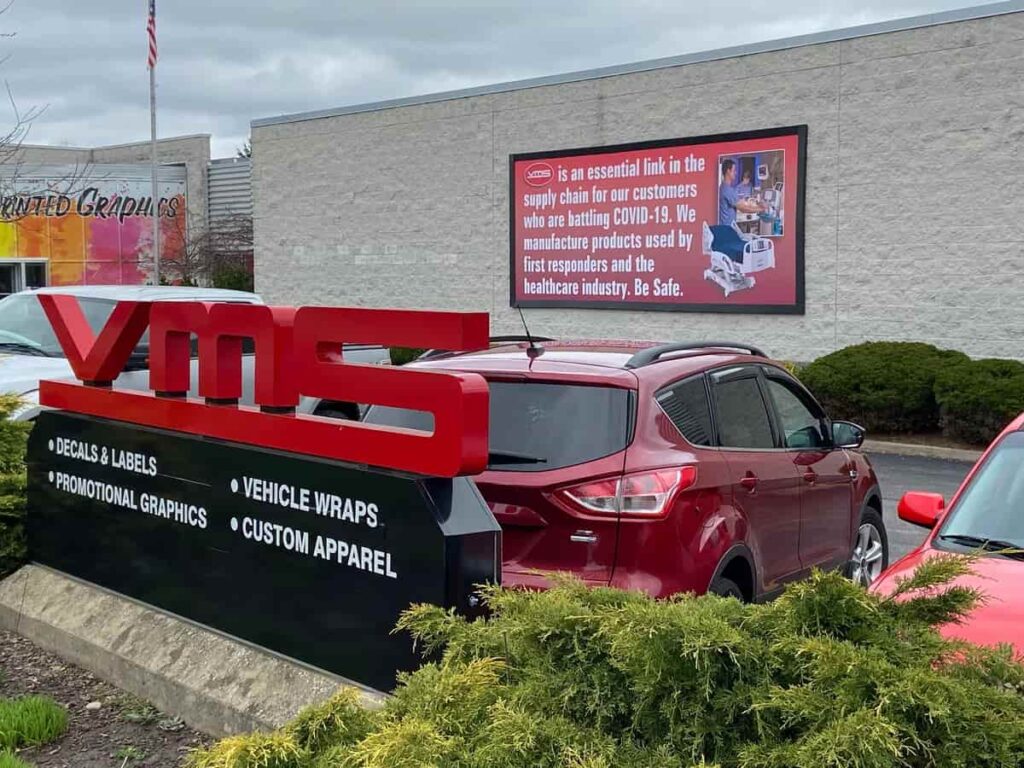
For AEM member company Visual Marking Systems (VMS), however, sustainability extends far beyond meeting regulatory requirements, minimizing waste, and maximizing bottom-line results. The Twinsburg, Ohio-based provider of digital, screen, and wide-format printing solutions doesn’t simply treat it as a siloed business function or standalone organizational initiative. Instead, VMS embeds sustainability in everything the company does each and every day in service of its customers.
"We focus on environmental stewardship, social responsibility, and economic viability," said Eric Kahle, president of VMS. "That’s because, for us, the strongest sustainability initiatives are the ones that become part of the normal way a business functions, rather than a separate program."
The Northeast leg of the AEM Manufacturing Express is proud to make a stop at Visual Marking Systems on Sept. 25, 2026. For more information and to follow along with the tour, visit manufacturingexpress.org.
A Multi-Pronged Approach to Sustainability
VMS has long embraced a number of key operational initiatives meant to reduce waste and enhance efficiency. In addition to the company’s longstanding and concerted application of LEAN manufacturing principles, VMS has actively participated in the following recycling programs:
- HP Planet Partners, which helps ensure printing supplies are recycled through a closed-loop process
- A coordinated effort with several insulation manufacturers to repurpose release liner backing that might otherwise end up in landfills.
But that’s not all. VMS has made strategic investments in energy-efficient equipment and facilities, all while offering customers access to more sustainable and recyclable material options appropriate for certain applications.
"These are practical examples where we can measure the impact of doing things differently," explained Kahle.
Alignment With Organizational Values
Well-intentioned sustainability-related activities and tactics are one thing. However, VMS has worked to take all its efforts to the next level by aligning everything directly with its core organizational values:
- Customer Focus
- Education
- Empowerment
- Innovation
- Profitability
- Urgency
“For us, education and empowerment give our employees the ability to identify opportunities for improvement,” said Kahle. “Then, customer focus means working with our customers to understand their sustainability objectives and requirements, as well as help them find solutions that make sense for their applications.”
Looking at everything through a lens of continuous improvement has also paid dividends for VMS, and it drives how the company approaches sustainability in both the short and long term. According to Kahle, VMS is always evaluating new technologies, materials, and production methods to reduce waste and energy consumption, all while striving to maintain high levels of deliverability related to quality and performance. Supplier relationships also play a key role for VMS, as developments in sustainable films, substrates, inks, and other materials are always changing over time.
“And just as importantly, we listen to our customers,” said Kahle. “Sustainability requirements are evolving. To be a qualified partner for any large organization, they will have sustainability requirements for the onboarding process. We also find that having a sustainability program or policy has become more frequently included in customer report-card scoring.”
Sustainability is everyone’s business. Whether it’s through aligning with ever-evolving regulations or working to support a more viable world, the non-road equipment manufacturing industry and its future depend on its ability to maximize efficiency, minimize cost, and use natural resources responsibly. Learn more.
What Others Can Take Away From VMS’ Sustainability Efforts
VMS is not unique in its efforts to move forward in its corporate sustainability journey. Many AEM member companies currently find themselves well positioned and motivated to take advantage of certain practical opportunities (and, with time, deliver measurable results). And while some are further along in their journey than others, the key for all companies in the earliest stages is to just get started and make some progress.
"You don't need to launch a massive sustainability program on day one," said Kahle.
According to the company, LEAN manufacturing principles serve as the perfect sustainability journey starting point for most organizations. In addition, company leaders should strongly consider taking a wide look at their operations and asking a few key questions before implementing strategies and tactics. They include:
- Where are we generating the most waste?
- What materials are routinely being sent to a landfill that could potentially be recycled or repurposed?
- Where are we consuming unnecessary energy?
- Are alternative materials available that still meet customer performance requirements?
- Are employees empowered to identify and suggest improvements?
In asking (and more importantly, answering) these questions, companies can identify achievable opportunities that improve efficiency while continuing to build momentum for broader sustainability efforts.
The Business Strategy Behind Sustainability
“From our perspective, the strongest sustainability initiatives are the ones that become part of the normal way a business operates, rather than a separate program,” said Kahle.
Waste reduction, improved efficiency, employee development, customer service… All of it can contribute to sustainability becoming good business practice. And while not every sustainability initiative is practical or cost-effective, taking advantage of well-conceived and actionable initiatives to drive progress is a more-than-worthwhile endeavor for organizations today.
“The truth is if you want to work with large companies, they will require that you have some sort of sustainable eye,” added Kahle. “But it doesn’t need to be overly burdening to you and your company. So, start small and publish your accomplishments.”