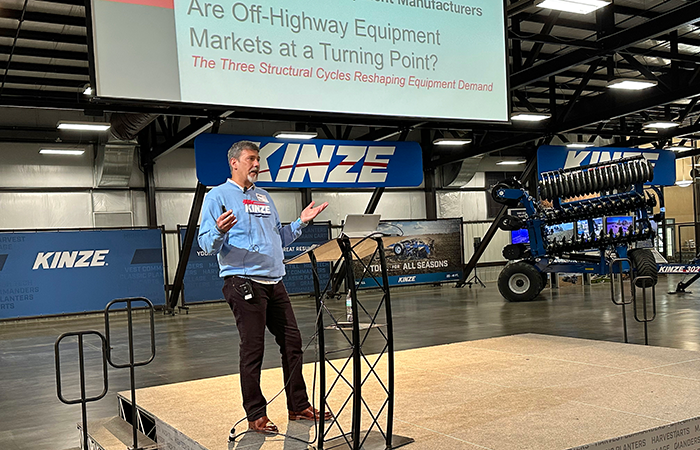
By Gregg Wartgow, Special to the Association of Equipment Manufacturers (AEM) --
What was expected to be a period of renewed growth has softened in the early months of the year, with tensions in the Strait of Hormuz adding another layer of uncertainty, particularly for agriculture, which was already facing a challenging outlook, while construction momentum in the U.S. has remained more insulated.
Early in the year, 2.32% growth in global construction output was anticipated. That forecast has been shaved by more than one-third to 1.52%. In the agriculture industry, negative financial indicators are flashing like they haven’t flashed since the early 1990s.
In the midst of all the external shocks and market disruptions, an increasing divergence between the agriculture and construction industries has also emerged — and it’s impacting equipment demand.
“Over the past year or so, public policy has been highly supportive of construction, but comparatively punitive for agriculture,” said Al Melhim, AEM’s senior director of business intelligence.
Melhim is referencing the $1 trillion public investment in non-residential construction in 2025 and 2026 to help support data center construction, advanced manufacturing, and the digital economy. “Ladies and gentlemen, that number is equivalent to the entire Swiss GDP,” Melhim pointed out.
Conversely, Melhim said the agriculture sector has suffered $21 billion in losses just from tariff retaliation alone.
“This policy-driven imbalance has had a material impact on equipment demand and helps explain why agriculture and construction have diverged so sharply within the past year,” Melhim said, adding that construction equipment has been reaccelerating while ag equipment remains stuck in a contraction.
Melhim was a featured presenter during AEM’s “Business Intelligence Q2 Equipment Market Update Webinar” on May 7, held in conjunction with AEM’s first Momentum Event of the year. Melhim, together with Tom Hopgood, a construction economist for GlobalData, discussed the fluid situations in the ag and construction industries that have been rocked by one external shock after another.
Stay on top of emerging industry trends with AEM’s quarterly Business Intelligence Equipment Market Update webinars, where leading experts break down industry issues and pinpoint crucial changes in the landscape to AEM member companies refine their strategies. Save your spot at our full lineup of these 2026 webinars .
North American Agriculture
The North American agriculture industry remains under stress, creating an unpredictable outlook.
In the U.S., the sale of high-horsepower equipment (100+ hp 4WD tractors and self-propelled combines) appears to have entered another deep downturn. Sales in 2025 and 2026 are near cycle lows, posting their weakest level since the early 1990s. This type of equipment is heavily tied to row crop farming. Weak farm incomes have forced farmers to extend equipment lifecycles, which is negatively impacting demand for new equipment.
Low-horsepower equipment is faring better. Sales are more reliant on diversified farming operations and the livestock sectors, which have been more resilient than row crop farming. Sales through 2025 hovered near the historic average. So far this year, indicators are suggesting a period of stabilization driven by healthier livestock margins and steadier farm cashflows.
Canada has seen a similar trend in the low-horsepower equipment category. In the high-horsepower category, the Canadian downturn has been far less drastic than in the U.S.
One positive sign in North American agriculture is that OEMs and dealers have been successful at constraining shipments and reducing inventories of high-horsepower equipment. “This is always better than flooding a weak market with more product,” Melhim said.
The market has definitely been weak.
Melhim said financial indicators are now signaling deeper stress and worsening credit conditions. Net farm income is expected to decline by about $7 billion this year. Additionally, the average debt-to-asset and debt service ratios are climbing, and bankruptcy rates and ticking up.
“What all this means is that farmers will be less able or perhaps willing to make large-ticket capital investments,” Melhim said. “We’ll need to see this trend reverse before we see increased demand coming through. Right now, any signs of that happening are very slim.”

“Over the past year or so, public policy has been highly supportive of construction, but comparatively punitive for agriculture.” -- Al Melhim
Global Construction
After posting slightly negative growth in 2025, a downgraded forecast of 1.52% growth in global construction output is now expected this year. The U.S. and Canada are projected to see 1.1% and 2.6% growth, respectively. The strongest region, South Asia led by India, is forecasted to see 6.3% growth. One region, North-East Asia led by China, is expected to see slightly negative growth this year.
“People were expecting this reacceleration of growth this year,” Hopgood said. “But as we’ve entered into 2026, we’ve had a thrill a minute.”
More thrills are anticipated, as forecasts are likely to be adjusted further after the full impacts of the Iran conflict begin to make their way downstream. Energy, freight, and construction materials costs have already been feeling some of those impacts.
According to Associated Builders and Contractors (ABC), construction materials prices were up 4.8% year-over-year in March, the largest annual gain since January 2023. Hopgood said this development will likely lead to eroded profit margins, and potential project delays and cancellations.
Taking a sector-level view of construction output, energy/utilities and infrastructure have continued to lead the way, followed by industrial construction. Residential and commercial construction continue to lag below 2019 levels. On a positive note, all six sectors should return to growth in 2027.
One emerging trend relates to data center construction. Although it represents just 2% of total construction output, it is a hot segment within the broader commercial sector.
“Data center construction actually took over office construction in January,” Hopgood said. “Also, one in seven contractors report having a data center project. That speaks to some changing trends in the market.”
That said, there has been a growing amount of grassroots pushback on data center construction across the U.S. As of early May, at least 12 states had proposed legislation designed to at least stall the construction of data centers. Local concerns over the impact on water supplies and electricity costs have driven much of the grassroots activism.
Impacts of the Iran Conflict
The full impacts of the Iran conflict are yet to be known. Much depends on how the conflict ultimately plays out. Hopgood said a quick bilateral agreement could result in a relatively speedy recovery and global reacceleration of construction output. On the other hand, a prolonged and perhaps escalated military conflict could result in a major energy shock, cost-push inflation, and sustained recession.
The International Monetary Fund (IMF) has already ramped up the odds of a global recession to 30%.
The big impacts on the construction industry are fuel and energy prices, supply chain shocks, and the lagging effect of those factors on the cost of things like copper wire and cable, cement, construction steel, and other construction materials.
In the agriculture sector, the price of diesel fuel obviously puts a dent in farmer profitability. Melhim said fertilizer prices could prove to be equally challenging.
One-third of global fertilizer trade moves through the Straight of Hormuz. Global urea and phosphate supply is already running 35-47% below capacity.
“It’s a crisis for those who use fertilizer for their own well-being,” Melhim said.
One thing to note is that, in the U.S., the impact of the fertilizer crisis varies by region. For instance, it is estimated that two-thirds of farmers in the Midwest prebook their fertilizer purchases. Conversely, just 19% of farmers in the South prebook, leaving them more exposed to today’s price volatility. Regardless, 60% of farmers are already paying higher prices for their fertilizer, and even half of Midwestern farmers said they cannot afford all of the fertilizer they need this year.
Switching back to the rising cost of diesel fuel, Melhim said there could be one upside for American farmers. Demand for biofuel and biodiesel tends to rise during times like this, which could bode well for corn and soybean farmers. Additionally, the EPA has established record high renewable fuel obligations for 2026-2027.
“This is one positive development that couldn’t come at a better time for the ag industry,” Melhim said.
About Quarterly Webinars
AEM members have exclusive access to benefits to help them stay on top of emerging trends via quarterly Business Intelligence webinars. Experts dissect industry issues and pinpoint crucial changes in the landscape to help attendees refine their company’s strategy.
Plan to attend AEM’s Q3 Business Intelligence Equipment Market Update Webinar on Aug. 6, 2026. A special thank‑you to Trelleborg Sealing Solutions for serving as our Title Sponsor of this year’s Business Intelligence Market Update webinars!
For more information on the upcoming Q3 Equipment Market Update Webinar, contact your Account Success Advisor.